
 By
By Elizabeth Tweedale studied computer science at a point when the room was mostly men who had been taking machines apart since childhood. She had the coursework. What she did not have was the decade of informal tinkering that everyone else appeared to treat as the baseline, and the gap read to the room as aptitude rather than as history.
That experience is now a design constraint. Coco Coders, the online coding school she founded in 2016, is built for children who do not think of themselves as coders.
“Coco Coders is explicitly designed against that pattern,” Tweedale said.
Her route in was not conventional. She had been building and patenting technical systems well before generative AI arrived in boardroom vocabulary, and the company reflects that longer view. Coco Coders treats coding less as a vocational skill and more as a way of seeing how industries are built.
The founding observation came from her own house. Her daughter announced at five that she would be a veterinarian, then reconsidered.
“She realized you actually have to deal with really sick pets,” she said. “The dream dissolved because the reality was sad, not just cuddly.”
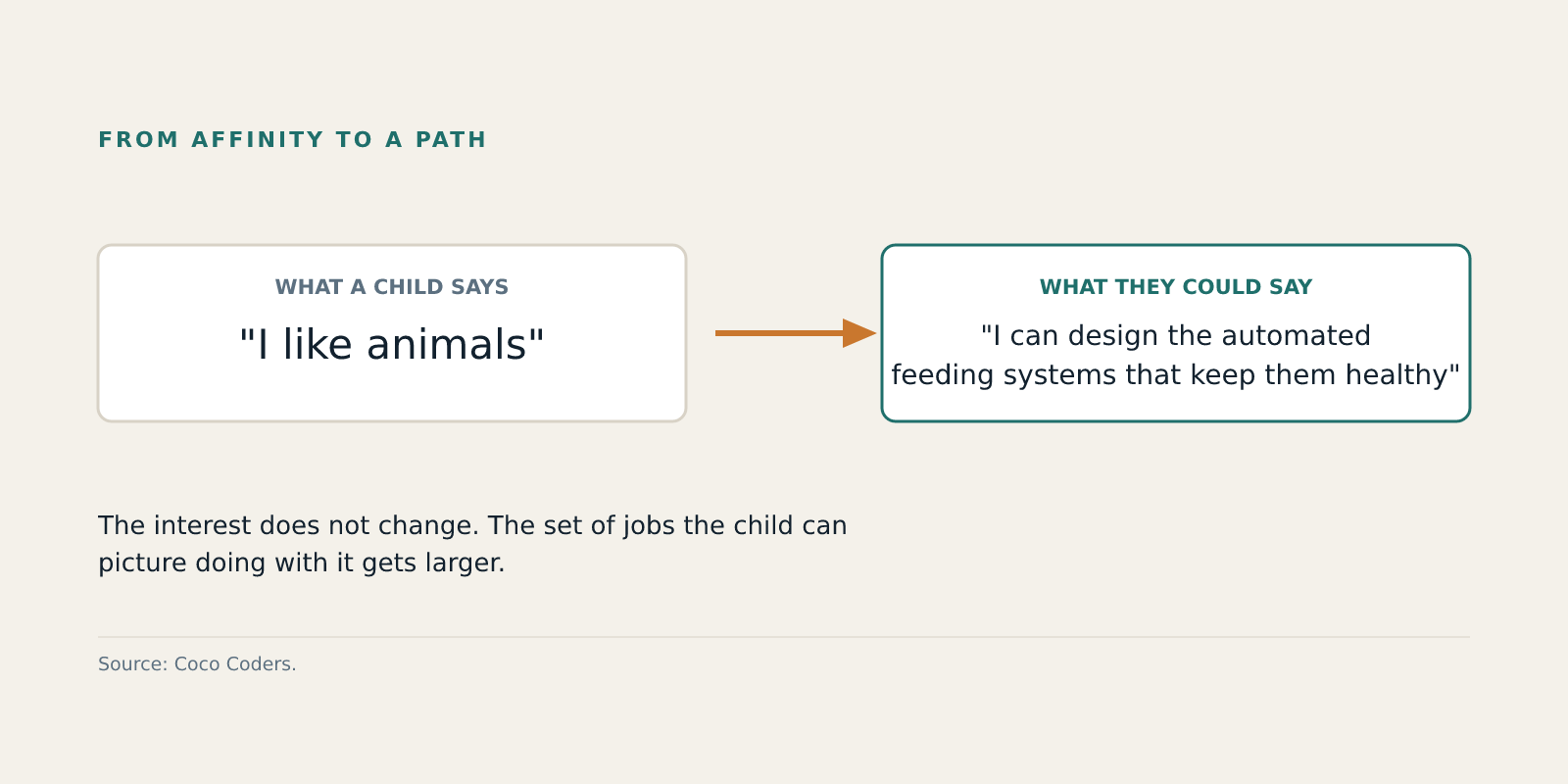
Read once, it is a parenting story. Read again, it describes how most career decisions get made: on an image, tested late or never.
Before writing the curriculum, Tweedale’s team interviewed high school principals across the United States. Students were arriving without technical fluency, and without any working map of the professional world. The second problem shaped the product.
Coco Coders runs ten-week foundation blocks followed by four-week deep dives anchored on a real technology. In an ocean conservation module, students study Mr. Trash Wheel, the solar-powered device intercepting rubbish in Baltimore’s Inner Harbor, then design their own response to the same problem. Children of primary and early secondary school age work through Scratch, Python, HTML, CSS and JavaScript in live online classes.
Two entry points run through the same material. A student oriented toward mechanics works on game logic and back-end structure. A student oriented toward narrative builds the world and the interface. The literacy at the end is the same, which is the part Tweedale’s own cohort got wrong.
The urgency argument rests on outside research rather than company data. The OECD found in 2020 that seven-year-olds’ career aspirations, already shaped by gender stereotypes and social background, barely change by seventeen. Education and Employers found in 2018, across more than 20,000 primary school children, that under one percent had learned about their chosen job from someone visiting their school.
Coco Coders has taught students in the US, the UK and internationally since it was founded in 2016.
Course information is published at cococoders.com.
About Coco Coders
Coco Coders is an online coding school founded in 2016 by Elizabeth Tweedale. It teaches Scratch, Python, HTML, CSS and JavaScript to school-age children through live interactive classes in group and private formats, and works with students in the United States, the United Kingdom and internationally. Course information is published at cococoders.com.